How to Tell if a Food Is Really Whole Grain
Look for the word "whole" before the grain in the first ingredient. Here's which label terms mean whole grain, which don't, and a fiber check to back it up.
On this page
A food is whole grain when its grain ingredients still contain all three parts of the kernel: the bran, the germ and the endosperm. The most reliable check is the ingredient list. The first ingredient should say “whole” in front of the grain, as in whole wheat flour or whole oats, or name a grain that is whole by nature, like brown rice, oats or quinoa. Color, a “multigrain” banner or a sprinkle of seeds on top tells you very little.
What “whole” actually means
Every grain kernel has three parts. The bran is the outer layer, rich in fiber, B vitamins and minerals. The germ is the small embryo, with healthy fats, vitamin E and more B vitamins. The endosperm is the starchy center, which supplies most of the energy and some protein.
Refining strips away the bran and germ, leaving mostly endosperm. That gives a softer texture and longer shelf life, but it removes most of the fiber. “Enriched” flour has certain B vitamins, folic acid and iron added back after milling. The fiber is not replaced.
Label words decoded
| Usually means whole grain | Doesn’t necessarily mean whole grain |
|---|---|
| whole wheat or whole-wheat flour | wheat flour |
| whole oats, oats, oatmeal | enriched flour |
| brown rice, wild rice | multigrain or 7-grain |
| whole rye, whole barley, hulled barley | 100% wheat |
| bulgur (cracked whole wheat) | stone-ground |
| whole cornmeal or whole-grain corn | made with whole grain |
| quinoa, buckwheat, millet, sorghum | bran or wheat germ on their own |
| popcorn | semolina or durum flour without the word “whole” |
A few in the right-hand column need explaining. “Multigrain” just means more than one grain, and any of them may be refined. “100% wheat” means the flour came from wheat, not that it kept the bran and germ. Bran and wheat germ are nutritious parts of the kernel, but adding them to refined flour doesn’t make the food whole grain. Pearled barley has had some of its bran polished away, so hulled barley is the whole version.
Check the first ingredient, then the second
Because ingredients are listed by weight, a whole grain in first place means it’s the main ingredient. Phrases like “made with whole grain” can describe products in which whole grain is a small part of the recipe. If enriched flour comes first and whole wheat flour third, the product is mostly refined. When a food uses several grains, see whether the whole ones come before the refined ones. Our guide to reading an ingredient list explains the ordering rules.
Use fiber as a cross-check
Whole-grain foods usually carry noticeably more fiber than their refined versions. One rule of thumb nutrition researchers have proposed is a ratio: at least 1 gram of fiber for every 10 grams of total carbohydrate. A slice of bread with 20 grams of carbohydrate and 2 or more grams of fiber meets it.
It’s not a perfect test, since a manufacturer can raise fiber by adding isolated fibers or bran to refined flour, so use it together with the ingredient list. FDA’s labeling terms help too: a “good source of fiber” provides at least 10% of the Daily Value per serving, and an “excellent source” provides 20% or more.
Don’t judge by color or texture
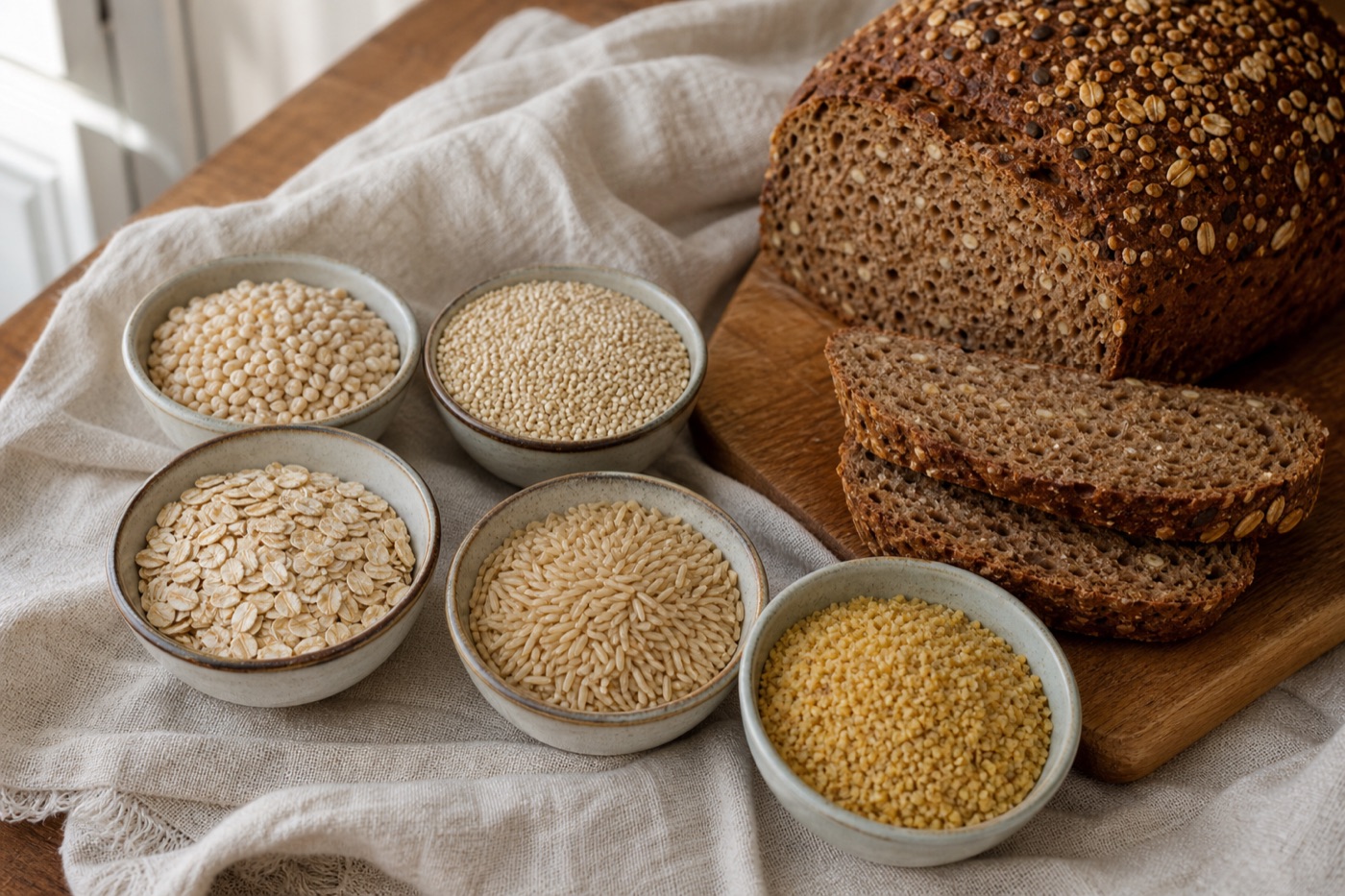
A dark loaf can get its color from molasses or caramel color. On the other hand, white whole-wheat bread is made from a paler variety of wheat and can be fully whole grain despite its light color. Oats or seeds pressed onto the crust are a garnish, not proof of what’s inside.
Whole grains you might already eat
Whole grains aren’t limited to bread and cereal. Many familiar foods count:
- Popcorn
- Oatmeal, whether rolled, steel-cut or quick
- Brown rice and wild rice
- Bulgur, the base of tabbouleh
- Hulled barley in soups and stews
- Quinoa, buckwheat and millet
- Whole-wheat pasta and whole-wheat couscous
How much to aim for
The 2020–2025 Dietary Guidelines advise making at least half of your grains whole. In a 2,000-calorie eating pattern, that means at least 3 of the day’s 6 ounce-equivalents. One ounce-equivalent is about 1 slice of bread, ½ cup of cooked rice, pasta or oatmeal, 1 cup of flaked cereal or 3 cups of popped popcorn. A bowl of oatmeal at breakfast and a sandwich on whole-grain bread at lunch can get you there before dinner. For help in the bakery aisle, see our guide to choosing a healthier bread.
If you have celiac disease, remember that wheat, barley and rye contain gluten, and oats are often cross-contaminated unless labeled gluten-free. A doctor or registered dietitian can help you build a whole-grain plan that’s safe for you.
The quick test
Find the word “whole” (or a naturally whole grain) at the top of the ingredient list, glance at the fiber, and ignore the color. Those three steps sort out nearly every box and bag on the shelf.
Common questions
Is whole-wheat bread the same as whole-grain bread?
Whole wheat is one kind of whole grain. A loaf labeled whole grain may combine several, such as wheat, oats and rye. Either works well as long as the whole grains lead the ingredient list.
Are oats always whole grain?
Yes. Steel-cut, rolled and quick oats all keep the bran and germ; they differ mainly in how they're cut and flattened, which changes the cooking time. Flavored instant packets often add sugar, so check that part of the label.
Is brown bread always whole grain?
No. Some breads get their color from molasses, caramel color or a small amount of whole-grain flour mixed into refined flour. Only the ingredient list tells you which flour dominates the loaf.
Sources
Naomi edits Nutrition for Everybody and writes the app rankings. She cares most about advice that still works on a Tuesday night with a tired family and a half-empty fridge.