How to Reduce Food Waste at Home
Cut food waste at home by shopping with a plan, reading date labels correctly, storing food at the right temperature and turning leftovers into new meals.
On this page
The most effective ways to reduce food waste at home are to buy only what you have a plan for, understand what date labels really mean, store food at the right temperature, and give leftovers and odds and ends a second life. USDA estimates that 30 to 40 percent of the U.S. food supply goes uneaten, and a good share of that is lost in home kitchens, so small habits really add up.
Where waste starts
Food usually gets thrown out for a handful of predictable reasons:
- Overbuying, especially perishable produce and big “bargain” packs
- Forgetting what’s in the back of the fridge or the bottom of the freezer
- Misreading date labels and tossing food that’s still good
- Cooking too much without a plan for the extra
- Discarding usable parts, like stems, peels and bread ends
Knowing which of these is your weak spot tells you where to start.
What date labels really mean
Except for infant formula, product dating isn’t generally required by federal law, and the phrases on packages can be confusing. Here’s how the USDA Food Safety and Inspection Service explains them:
| Label wording | What it means | Safe after the date? |
|---|---|---|
| Best if used by / before | When the product will have the best flavor or quality | Usually, if stored properly and it shows no signs of spoilage |
| Sell by | How long the store should display the product, for inventory | Yes; it’s not a safety date |
| Use by | The last date recommended for using the product at peak quality | Generally, except on infant formula, where it should be followed |
| Freeze by | When to freeze the product to keep peak quality | Not a safety date; freeze before it to preserve quality |
Your senses and storage matter more than the stamp. Food that smells off, looks slimy or has visible mold on soft items should be discarded even if the date hasn’t passed.
Store food so it lasts
Temperature is your biggest tool. Keep the refrigerator at 40°F or below and the freezer at 0°F, and check with an appliance thermometer, since built-in dials can be off.
A few organizing habits keep food visible and moving:
- First in, first out. Put new groceries behind older ones.
- An “eat first” bin. Give leftovers, half-used ingredients and ripening produce one clearly marked shelf or bin.
- Clear containers. You’ll use what you can see.
- Label and date everything that goes into the freezer.
Different fruits and vegetables need different conditions; some last longer on the counter, others in the crisper drawer, and some give off gases that speed ripening in their neighbors. The specifics, item by item, are in our produce storage guide.
Shop, cook and repurpose
Before you shop
- See what’s already on hand in the refrigerator, freezer and cupboards; a quick photo on the way out helps at the store.
- Plan meals for most, not all, of the week so there’s room for leftovers.
- Write a list with quantities and stick to it.
- Buy loose produce in the amounts you need, and choose frozen fruit and vegetables for anything you use slowly.
When you cook
- Cook to the number of people eating, or cook extra on purpose with a plan for it.
- Use the whole vegetable: broccoli stems can be peeled and sliced, beet and radish greens can be sautéed, and herb stems can flavor soups and sauces.
- Serve smaller portions and let people go back for seconds.
Second lives for odds and ends
- Soft fruit: blend into smoothies, stir into oatmeal or bake into muffins.
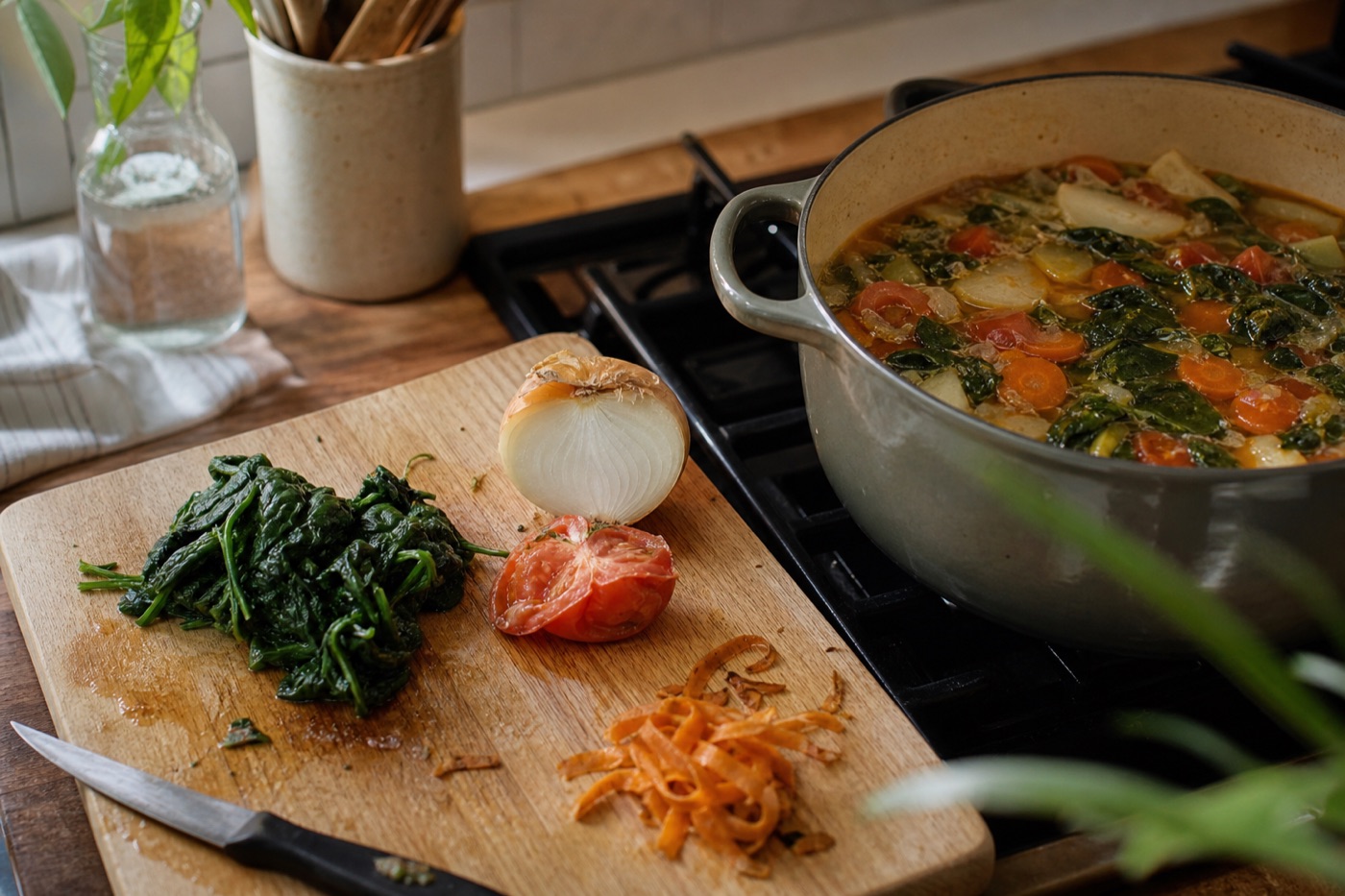
- Wilted greens and tired vegetables: soups, frittatas, stir-fries and pasta sauces. See our ideas for soups and stews that pack in vegetables.
- Stale bread: croutons, breadcrumbs or bread pudding.
- Vegetable scraps: onion skins, carrot peels and celery ends simmer into stock; freeze them in a bag until you have enough.
- Leftover rice or grains: fried rice, grain salads or a filling for peppers.
- Overripe bananas: freeze them for smoothies or banana bread.
Solo cooks will find more on buying and cooking in smaller amounts in our single-serving kitchen guide.
Know when to let it go
Reducing waste never means taking chances with food safety. A few firm rules:
- Refrigerate cooked food within 2 hours, and within 1 hour if it’s been above 90°F.
- Finish chilled leftovers in three or four days, or move them to the freezer.
- Discard soft foods with mold, such as soft cheeses, yogurt, bread and soft fruit; hard cheese and firm vegetables can often be saved by cutting away at least an inch around the moldy spot.
- When in doubt, throw it out.
If you have space, composting fruit and vegetable scraps keeps them out of the landfill. Many communities also offer yard-waste or food-scrap collection.
Make it a habit
Pick one change to start with, such as an “eat first” bin or a weekly fridge check before shopping, and keep it up for a month. Once it’s automatic, add another. Over time, planning, smart storage and a few creative leftover meals save money, time and a surprising amount of food.
Common questions
Is food safe to eat after the best-by date?
Usually, yes, if it has been stored properly. A best-by date marks peak flavor or quality, not safety; check for signs of spoilage such as an off smell, mold or a changed texture before eating.
What is the right temperature for my refrigerator?
Federal food safety guidance calls for 40°F or colder in the fridge and 0°F in the freezer. Built-in dials aren't always accurate, so a cheap appliance thermometer is worth having.
Can I freeze leftovers I won't finish in time?
Yes. Freezing at 0°F keeps food safe indefinitely, though quality slowly declines. Freeze leftovers within 3 to 4 days of cooking, in labeled, dated containers.
Sources
Naomi edits Nutrition for Everybody and writes the app rankings. She cares most about advice that still works on a Tuesday night with a tired family and a half-empty fridge.